Global Cleanroom Expertise: Capabilities

Global Cleanroom Expertise: Capabilities

As you may already know, the Angstrom Technology Group of market leading cleanroom companies in the US, UK, and Europe has capabilities to provide multinational services to our global clients. But what does this mean for our customers?

The stringent control of process variables is a global requirement for pharmaceutical, electronics, and biotech industries worldwide. Our cleanrooms support top-tier multinational organizations to increase quality at sites across the world.


EXPANDED PRODUCT RANGE

Through in-house expertize and collaborations with specialist industry-partners, we can deliver facilities with precise requirements, such as battery dry rooms or cell and gene therapy suites.


CONSISTENT QUALITY

When it comes to global operations, maintaining consistent quality standards is crucial. Angstrom Technology understands this well and no matter where you are in the world, we can deliver compliance to the applicable regulations. This commitment to quality gives you the reassurance that partnering with Angstrom Technology will result in reliable and high-performing solutions for your business.


FASTER RESPONSE TIMES

In a fast-paced business environment, time is of the essence. Angstrom Technology’s global network of partners enable us to reduce shipping and installation times significantly. This streamlined approach translates into improved operational efficiency for your business, giving you a competitive edge.


LOCALIZED SUPPORT CAPABILITIES

By having a network of support teams strategically located across different regions, Angstrom Technology ensures that you receive personalized attention and timely assistance. This localized approach strengthens our commitment to customer satisfaction and builds long-lasting partnerships.


COMPETITIVE PRICING

Angstrom Technology’s global capabilities enable them to optimize their supply chain and take advantage of economies of scale. This optimized approach allows them to offer competitive pricing without compromising on quality. By partnering with Angstrom Technology, you can access cost-effective contamination control.


ACCESS TO GLOBAL EXPERTIZE

With a multi-disciplined, in-house team of cleanroom experts, we have expansive industry experience, with applied knowledge and skills across the globe, such as our global regulatory governance team.


GLOBAL CLEANROOM PROJECTS
 

Capabilities - Global cleanroom customers


SPEAK WITH THE EXPERTS AT ANGSTROM TECHNOLOGY

If your facility needs a new cleanroom, Angstrom Technology can design, build, and install one that meets your specifications. Using proven design strategies and quality build systems, you can trust that your work and employees will always be protected.

Request a cleanroom quote today, or contact our team for more information.

Global Cleanroom Expertise: Regulatory Governance Team

Global Cleanroom Expertise: Regulatory Governance Team

The regulatory landscape for cleanrooms can be complex. On top of managing the requirements of the ISO 14644 suite of standards, you may also need to comply with cGMP (Good Manufacturing Practice) guidelines and those of industry regulatory bodies. But the experts at Angstrom Technology are committed to supporting you through successful audits. All cleanroom projects with a requirement for cGMP compliance have oversight from our dedicated regulatory governance team. 

With over 40 year’s combined experience in cGMP and pharmaceutical industries, this level of in-house expertise sets us apart from other cleanroom companies. In this blog — the first in our Global Cleanroom Expertise series — we explain how we can support your regulatory compliance.  


Meet the Regulatory Governance Team

Global Compliance and Quality Assurance Manager

Global Compliance Lead

Joan Benson - Global Compliance and Quality Assurance Manager Simon Rice - Global Compliance Lead
Joan has 30 years previous experience in Cell and Gene Therapy, Academia, Pharmaceutical Industry, Contract Clinical Research and Hospital Aseptic facilities. She was front facing regulatory inspections in MHRA, FDA, HTA and HFEA for 20 years. Simon has 8 years previous experience in the production of radiopharmaceuticals within a fully accredited GMP facility manufacturing sterile pharmaceuticals. This gives him a unique understanding on the implications of GMP.


Regulatory compliance services

Our cleanroom systems can be qualified to cGMP, and the required ISO classification. Not only that, but they can also meet any applicable international engineering and building standards and regulations. Our skilled and multi-faceted team can provide the following key services to support your compliance: 

  • Design Qualification (DQ), Installation Qualification (IQ), Operational Qualification (OQ), Performance Qualification (PQ) 
  • Factory Acceptance Testing (FAT), Site Acceptance Testing (SAT) 
  • Validation 
  • Audits of facilities and Quality Management Systems 
  • Gap analysis 
  • Mock regulatory inspections 
  • Bespoke validation studies 


Regulatory governance successes

Our team has led high-profile global cleanroom projects to regulatory compliance. There are just a few of their recent successes. 

  • Led cleanroom validation (DQ, IQ, OQ, PQ, FAT, SAT and a wrap-around validation package covering EMS, VHP systems and cryostorage) for a 33-room Cell and Gene Therapy Manufacturing Facility. 
  • Led cleanroom validation (DQ, IQ, OQ, PQ, and all commissioning data) for a 6,500 Cleanroom Facility in their 11,000 square feet Single-Use Bioprocessing Technologies Manufacturing Facility. 
  • Supported numerous clients on the delivery of their projects with regulatory support on all aspects including design, validation, and commissioning 
  • Led cGMP qualification packages for current clients with GMP facilities 
  • Gap analysis for leading clinical research units 


Ready to start your cGMP cleanroom project? Contact us

We are committed to supporting you through successful audits and inspections, now and in the years to come. To learn more about our cGMP cleanroom design-build services, request a quote or contact us. 


Cleanroom Construction in your Existing Structure

Cleanroom Construction in your Existing Structure

Constructing a cleanroom in any space is a major advantage of the modular cleanroom building process. Let’s look at where you can build a cleanroom in your current space and what that process looks like.

Where Can You Construct a Cleanroom?

Retrofit cleanrooms can achieve any ISO cleanroom classification, and construction can happen in various spaces. However, the best type of cleanroom for each space may differ. Let’s take a look at three examples.

1.    Cleanroom Construction in a Large Industrial Space

If you’d like to construct a cleanroom in a large space such as a warehouse, you have a lot of freedom when it comes to the square footage and layout of your cleanroom. Although you have plenty of space, it’s important only to build the cleanroom as large as it needs to be. This will not only save you money on materials during cleanroom construction but will also cut down energy usage once the cleanroom is in operation.

In a large space, you can suspend modular cleanroom panels from a strong ceiling grid or build a freestanding cleanroom. Your cleanroom can also be constructed to include existing walls, utilize light from existing windows, and even connect to the utilities of the building — as long as they meet your cleanroom classification requirements. Any type of modular cleanroom is suitable for a large space, so you can choose between a HardWall, SoftWall, RigidWall, or Seamless cleanroom — whatever will be best for your application.

2.    Cleanroom Construction in Small Spaces

Although large spaces offer plenty of room to spread out, don’t discount smaller spaces for cleanroom construction. A flexible modular cleanroom type — such as SoftWall cleanrooms — can be highly effective in a tighter space. SoftWall modular cleanroom panels can be arranged into more condensed layouts than their HardWall or RigidWall counterparts while still achieving ISO Classes 4-8.

Additionally, the modular design means SoftWall cleanrooms can be set up quickly, easily reconfigured or taken down and stored, and moved virtually anywhere you need a cleanroom.

3.    Office Space to Cleanroom Conversion

Unused office space presents a great opportunity when looking for space to install a new cleanroom. A new cleanroom design can incorporate many elements of the existing structure. Depending on your cleanroom’s requirements, you may be able to use an existing ceiling grid, walls, and windows.

To convert office space into a cleanroom, you must upgrade each surface to create a flush, non-particle-shedding structure. HardWall cleanroom walls are ideal for office space conversions — offering a high level of control over environmental conditions within the space. The retrofit cleanroom design might also include antistatic flooring, a grid lighting system, and an airflow pattern that works with the customized space.


Cleanroom Retrofit Construction Process

The process of retrofit cleanroom construction in every space will look a bit different, as it’s highly customized to each application. It involves four main steps, of which the first two are the most critical. Those include site survey, design, construction, and installation.

1.     Cleanroom Site Survey

Cleanroom construction in an existing structure relies on the planning stages to ensure your space can support the cleanroom you need. Before any work begins, a cleanroom expert must assess the space to determine whether it will accommodate the necessary equipment, furniture, and personnel. They’ll also examine the quality of the room’s air to specify filtration needs and determine what systems can be adapted or replaced.

2.     Cleanroom Design

When designing your retrofit cleanroom layout, the cleanroom designer will need to factor in how the space influences the airflow pattern. A cleanroom design expert uses computational fluid dynamics to map out the airflow pattern for your application and layout. They’ll need to know where furniture and equipment will be installed to optimize the design.

3.     Cleanroom Construction

With the design complete, it’s time to move on to cleanroom construction. With modular cleanrooms, the structure is built to meet the design specification and the cleanroom’s classification standards. They are pre-wired and pre-insulated so they can be quickly assembled and installed in the existing building once they arrive.

4.     Cleanroom Installation

Finally, the cleanroom is ready for installation in your existing structure. The installation process will be straightforward after spending more time planning and designing the cleanroom to work in your space. Modular panels will be attached to existing walls, and new walls will be set up to be either freestanding or suspended. An installation team will install HEPA filters lighting systems in the ceiling, then connect the cleanroom HVAC system.

Cleanroom construction in an existing structure requires extra care and attention. Due to the cleanroom’s critical nature, we recommend having a team of experts install the cleanroom into your space to ensure a flawless end product. This way, you get a suitable cleanroom for your application and space.


Speak to the Experts at Angstrom Technology About Your Cleanroom Retrofit

Are you wondering if you can build a cleanroom in your space? Give Angstrom Technology a call! Our professional cleanroom designers can assess your site and design a cleanroom that will work perfectly in your space. To get started, give us a call or reach out to us online today.


Get Instant Access to Our Cleanroom Design Guide

The Most Comprehensive Guide for Cleanrooms and Modular Offices
Angstrom Technology Design Guide

How to keep a cleanroom clean

How to keep a cleanroom clean

It can be challenging to keep a cleanroom clean and maintain its ISO class. Everything you introduce will likely release particles into the air — especially people! So, what are the best ways to keep your cleanroom up to the standards you so painstakingly maintained? Here are some basic concepts and helpful suggestions to maintaining the highest level of cleanliness.

Gowning: First and foremost, anyone entering the cleanroom must wear protective clothing. Humans are full of particles: our hair falls out, our skin flakes, and there’s no way to control it. That’s why anyone entering the cleanroom must wear appropriate protective clothing. Depending on your cleanroom’s class, this might be a gown and gloves or a full head-to-toe cleanroom coverall complete with a mask and goggles. You first have to define your standards, but then you should know what your employees should wear in the cleanroom.

Cleaning: Why do you need to clean a cleanroom if it’s already clean? Because of the inevitable introduction, generation, and retention of particles! If you are concerned with bioburden, you don’e just need to clean. You need to clean and disinfect! This is a two-stage process. First, you clean away the dirt (or, as we call it in the cleanroom industry, non-viable contamination), then disinfect the germs (viable contamination).

Cleanroom Furniture: Believe it or not, furniture can give off particles even when it’s just sitting there. And even when furniture doesn’t generate particles, it can accumulate them. That’s why cleanroom furniture has smooth edges and joins. Without dirt traps, particles and dust won’t build up on furniture. You’ll need to invest in this type of furniture to keep your cleanroom clean.

Air Shower: To limit the number of particles brought into your cleanroom, you might consider investing in an air shower. Used in conjunction with the gowning room, it blows off any particles that could easily fall off people entering the cleanroom. It’s a great way to eliminate extra particles before operatives enter the room. The experience can also get operatives into the right mindset of controlling contamination.

Sticky Mats: This is the best way to reduce foot-borne or wheel-borne contaminates. If your cleanroom has a high standard for cleanliness, this is a useful addition to your cleanroom.

Proper Cleanroom Gowning Techniques

The cleanroom gowning process may seem like a hassle, but you spend a lot of money getting the cleanroom installed and maintained, so a few extra minutes gowning properly isn’t a big deal if you’re protecting that asset and keeping your cleanroom as clean as possible. But what, exactly, do you have to do to make sure you and your employees are following proper protocol and protecting the environment of the cleanroom? It starts with a standard procedure. It will be much simpler if everyone follows the exact same process and understands the different areas of the gowning space. Generally, most gowning spaces have a “getting dressed” area and a “cleaner” area. Make sure employees understand these boundaries, and know where to stand at what point in the gowning process. Here’s an example of a standard gowning process. Remember, however, that most gowning processes will vary depending on the standard you’re required to adhere to.

  1. Perfume and Cosmetics – If you’re working in a cleanroom, the gowning process starts before you even get to work. It’s important to remember that products like perfume, make-up, hair gels, etc. give off extra fumes and particles. To keep your cleanroom as clean as possible, it’s necessary that anyone entering the room not wear these types of products.
  2. Remove personal items – Personal items like jewelry also have to come off before you go into your cleanroom. They, just like cosmetics, release extra, unnecessary particles into the air that you’re better off without.
  3. Change Shoes – Shoes pick up all kinds of dirt and dust when you walk around. It’s a good idea to change your shoes once you walk into the building, and then as you enter the gowning area, make sure you step on a sticky mat to remove any excess particles.
  4. Enter Gowning Area – Now you’ll enter the gowning room, and most places have a “getting dressed” area, which is where you’ll start. Make sure to put on a set of “donning gloves” or just a first set of gloves to eliminate particle contamination of gowning clothes. When gowning, remember to dress from head to toe; this eliminates particles from falling onto already gowned parts like coveralls and booties.
  5. Don Bouffant – First, you’ll put on your bouffant, or hair cover. Make sure to only touch the inside of it, and before you move on, ensure that all hair is covered and out of the way. After this, you may also have to don a hood, depending on your cleanroom’s standards.
  6. Don Coverall – If your coverall is one piece, start with the feet and move upwards. If it’s two pieces, start with the top and then sit down to put on the bottom half. Do not let the coverall touch the floor or walls. Make sure you zip all zips, and snap all snaps.
  7. Booties or Shoe Covers – Now, sit on the bench to don booties or shoe covers. Make sure you tuck your pants into the booties or shoe covers, and don’t step in the “getting dressed’ area. Instead, step into the “cleaner” area of the gowning room. If your cleanroom has an automatic shoe cover dispenser, use that for cleanliest practice.
  8. Don Goggles or Shield – If your cleanroom requires them, this is where you put on your goggles or face shield. Some cleanrooms do not require this level of protection, so you may be able to skip this step.
  9. Final Pair of Gloves – Depending on protocol, you may now remove the first pair of gloves and put on a second, or you may put a second pair of gloves over the first. Roll the cuff of the gloves over top of your sleeves.
  10. Enter – Now that you’ve properly gowned, you may enter the cleanroom. Remember that at this point you are as “clean” as you’re going to get, so if you touch anything before you get inside, you’ll have to start over, or at the very least change your gloves.

If you have any more questions regarding the information provided above, please reach out to one of our experts. The experienced experts at Angstrom Technology can answer any of your questions quickly and efficiently, and would love to hear from you!

Get Instant Access to Our Cleanroom Design Guide

The Most Comprehensive Guide for Cleanrooms and Modular Offices
Angstrom Technology Design Guide

The best wall panels for a dry room for battery manufacturing

The best wall panels for a dry room for battery manufacturing

Our recent blog post discussed HVAC systems that deliver low dewpoint air to create a dry room for battery manufacturing. But we can’t overlook the importance of an envelope system in a dehumidification system. A fully sealed panel system with well-sealed doors will insulate and protect a dry room from moisture ingress. The experts at Angstrom Technology can create a stable low dewpoint production environment to meet your requirements. In this blog post, we explain how.

DRY ROOM WALL PANELS FOR BATTERY MANUFACTURING: ROBUST & SEAMLESS

A critical cleanroom envelope decision is the construction and surface finish the panel, which must consider cleaning regimes, robustness, and surface resistivity. The latter is often most important within the battery, semiconductor, and microelectronics industries.

A seamless (or flush) cleanroom system eliminates trapping points, allowing for the best particulate control possible. Vision panels and doors should have flush integrations to avoid dead zones in air flows and trapping points for particulate.

STATIC DISSIPATIVE PANELS

Static dissipative plastics have a surface resistance that allows electrical charges to dissipate within milliseconds. The use of static dissipative materials will allow charges to flow to the ground in a slow and controlled way, preventing discharge to or from human contact.

ANTI-STATIC PANELS

Anti-static materials usually have a surface resistivity that inhibits the build-up of electric charges created when two materials rub together. Suppressing initial charges prevents the build-up of static electricity and provides a very slow rate of static charge decay from a hundredth to several seconds. This method can control building envelope charges in micro-electronic facilities.

PANEL CORE

Electrostatic discharge (ESD) can cause lithium to catch fire or micro-electronic components to fry, so battery dry rooms must be designed and built to ground charges safely. Panels with PIR or PU cores are highly insulative, so they can trigger ESD, making them inappropriate for these environments. Instead, panels with an aluminum honeycomb core and either anti-static or static dissipative facings will help manage the grounding of charges.

FIRE RISKS

Ultra-low humidity levels combined with highly combustible materials give battery dry rooms a high fire risk, which needs careful management. A low surface spread of flame tested to ASTM E84 is essential.


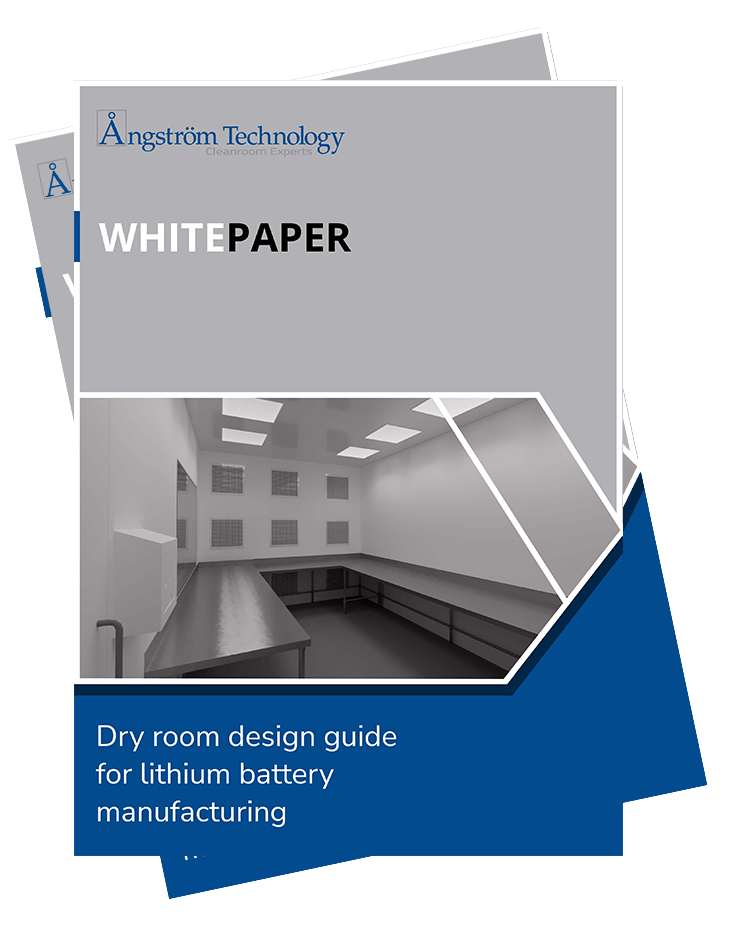
WHITEPAPER: DRY ROOM DESIGN GUIDE FOR LITHIUM BATTERY MANUFACTURING

DOWNLOAD OUR HANDY GUIDE:


dry room design guide

BATTERY DRY ROOM DESIGN & BUILD PROJECTS WITH ANGSTROM TECHNOLOGY

As Angstrom Technology are cleanroom specialists, our dry rooms can also achieve ISO classification. Not only that, but a dry room for battery manufacturing from Angstrom can also meet any applicable international engineering and building standards and regulations.

We’ve developed proven envelope solutions and reliable cleanroom HVAC designs for many applications. The Angstrom Technology group pride ourselves on our in-house expertise and capability to deliver over 100 cleanrooms annually across America, the UK, and Europe.

Tell us about your new dry room project!