MEDICAL DEVICE CLEANROOMS
Angstrom Technology designs and builds cleanrooms for the full spectrum of medical device applications, from early-stage R&D through high-volume production. Every cleanroom we deliver is tailored to reflect the unique contamination risks, regulatory requirements, and operational demands of your specific application.
Our modular medical device cleanrooms are fully reusable, reconfigurable, and built to last. Prefabricated modular panels insulate your environment, act as a barrier against airborne and surface contamination, and give you precise control over temperature, humidity, static, and pressure while providing faster and more cost-effective construction.
Medical device cleanrooms must satisfy some of the most rigorous contamination standards in any industry. Angstrom Technology’s cleanroom experts work with you from initial design through installation and ongoing maintenance to ensure your cleanroom meets particle count standards, quality management requirements, and any other applicable regulatory frameworks — and continues to comply throughout its operational life.
WHAT ARE MEDICAL DEVICE CLEANROOMS?
Medical device cleanrooms are controlled environments designed to limit airborne and surface particulate contamination during the manufacturing, assembly, packaging, and testing of medical devices. Because these products are ultimately used in clinical and surgical settings — often in direct contact with patients — the consequences of contamination can extend far beyond product failure. That’s why cleanroom standards for this industry are among the most stringently enforced in any manufacturing sector.
Unlike some industries where a single classification standard applies across most applications, medical device cleanrooms span a wide range of requirements. The appropriate classification is driven by the product, the process, and the regulatory framework governing the device — meaning a packaging operation and a sterile implantable device line may both be called “medical device cleanrooms” while operating under very different standards. Temperature, humidity, pressure, airflow patterns, gowning protocols, and materials selection all factor into maintaining contamination levels within classification limits, and each application demands its own design approach.
Angstrom’s modular cleanrooms for medical device applications are built with materials and components that support stringent contamination control: non-shedding wall panels, ESD-safe materials where required, and systems validated against your target cleanroom classification. Customizable features include air showers, pass-throughs, laminar flow systems, industry-specific furniture, and more.
Wall-system choice depends on classification and process. Hardwall and rigidwall systems are the most common for medical device cleanrooms, but seamless wall systems are well suited to the most critical, sterile applications, and softwall systems are used frequently across medical device work where flexibility and faster reconfiguration are priorities. We help you select the right system for your classification target and budget.

Hardwall Cleanrooms

Rigidwall Cleanrooms

Softwall Cleanrooms

Seamless Cleanrooms
MEDICAL DEVICE CLEANROOM CLASSIFICATIONS
Medical device cleanroom classifications are governed by ISO 14644-1, which defines allowable airborne particle concentrations for each ISO class, and — depending on the product being manufactured — by FDA requirements. The required classification depends on the specific application, the risk level of contamination to the product, and the stage of the manufacturing process.
Many medical device manufacturers also operate under ISO 13485:2016 quality management systems, which govern how organizations design, build, and maintain the processes and environments used to produce regulated medical devices. Where ISO 13485 applies, environmental controls, cleanroom monitoring, maintenance procedures, and contamination-control practices are typically incorporated into the manufacturer’s quality system documentation and validation programs — meaning the cleanroom itself, and how it is managed and maintained, becomes part of your compliance record.
A lower ISO class number means a cleaner, more stringent environment, and a higher number means a less stringent one. ISO Class 1 is the cleanest classification possible, while ISO Class 9 is roughly equivalent to normal room air. So when an application “requires ISO Class 6 or stricter,” that points toward ISO 6, 5, and 4 — progressively cleaner environments, not less clean ones. For a deeper look at how ISO classifications work, see our Cleanroom Classification Standards page.
Most medical device manufacturing cleanrooms fall within ISO Class 5 through ISO Class 8, though the appropriate class varies by application type. ISO Class 5 and stricter (lower ISO number) environments are required for the most contamination-sensitive processes, such as sterile device manufacturing or direct-contact implantable component assembly, where even minor particulate contamination can pose serious patient safety risks. Less contamination-sensitive operations, such as device packaging, typically operate at ISO Class 7–8.
Cleanrooms classified at ISO Class 5 and stricter (lower ISO number) are also evaluated at two distinct stages: “at rest” (all equipment in place, no active personnel or production) and “in operation” (full personnel and process activity). Both certification levels must be maintained, as particle counts increase substantially when the cleanroom is running at full capacity.
Under ISO 14644-2, cleanrooms undergo periodic performance verification to confirm ongoing compliance, conducted in accordance with the facility’s contamination-control strategy. In practice, many facilities requalify ISO Class 5 environments semi-annually and ISO Class 6–8 environments annually, along with routine airflow and pressure-differential verification.
MEDICAL DEVICE CLEANROOM DESIGN
Whether you are building a new cleanroom from the ground up, retrofitting an existing space, or upgrading a facility to meet stricter classification requirements, Angstrom Technology designs and installs modular cleanroom systems that are compliant with US building and safety codes and ready to support your operations from day one.
Cleanroom Systems & Fixtures
A well-designed medical device cleanroom integrates all critical systems — lighting, air filtration, and HVAC — into a cohesive environment that maintains classification compliance and supports operational efficiency.

Lighting

Air Filtration

Air Circulation
Featured Project
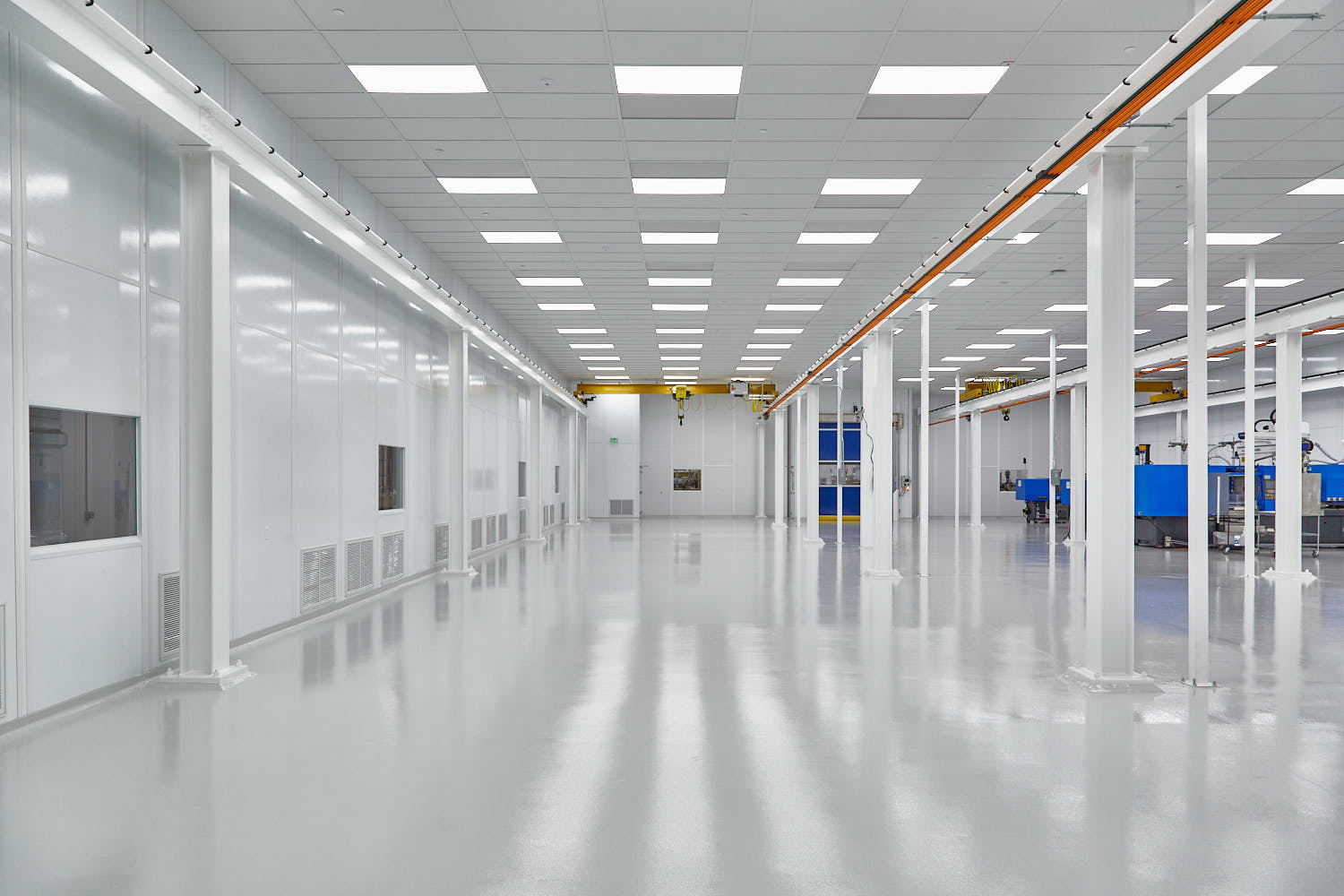
California Medical Device Project
This 50,000 SF project included three separate cleanrooms, a white room, utility corridors, and a two-story area consisting of a quality lab and conference room spaces to support the manufacturing of diagnostic consumables, medical devices and sub-assemblies.
MEDICAL DEVICE CLEANROOM APPLICATIONS
Medical device cleanroom requirements vary considerably across the design, manufacturing, assembly, and packaging stages of the product lifecycle. Angstrom Technology designs cleanrooms to meet the specific classification, layout, and systems requirements of each application.
Medical Device Manufacturing Cleanrooms
Manufacturing cleanrooms for medical devices typically fall within ISO Class 5–7, depending on the sensitivity of the components being produced. Direct-contact components and implantable devices require the strictest contamination control and the highest air change rates. Manufacturing environments must also control for static electricity, particularly in processes involving fine electronics or polymer components, making ESD-safe materials and grounding systems essential elements of the cleanroom design.
Medical Device Assembly Cleanrooms
Assembly operations frequently involve close handling of device components by personnel, making human-generated contamination a primary design consideration. Proper airflow patterns — typically laminar, or unidirectional, flow in more stringent environments — are critical to preventing particle accumulation at the point of assembly. Cleanroom layout, gowning room placement, and pass-through systems all contribute to maintaining cleanliness during active production.
Medical Device Packaging Cleanrooms
Packaging environments are designed around product risk, packaging method, and contamination sensitivity. ISO Class 7 and ISO Class 8 environments are common, though requirements vary by manufacturer and product type. Many sterile packaging operations combine an ISO Class 7 or 8 background with controlled non-classified (CNC) areas and localized ISO Class 5 protection over critical exposure points, depending on the risk assessment. Whatever the configuration, maintaining contamination control through this final stage is critical to keeping the device sterile through distribution and storage, and packaging cleanrooms must account for the high volume of materials and personnel movement typical of these operations.
Medical Device R&D and Testing Cleanrooms
Research and development environments can range from general laboratory space to fully ISO-classified cleanrooms — commonly ISO Class 5–7 when classification is required — depending on the nature of the product, the testing protocol, and the contamination sensitivity of the work being performed. Beyond particle count, testing environments may also require precise environmental controls, including tight temperature and humidity tolerances, to ensure test result accuracy and product integrity.
FREQUENTLY ASKED QUESTIONS
What ISO class does a medical device cleanroom need?
It depends on the application. Most medical device cleanrooms fall between ISO Class 5 and ISO Class 8. Sterile and implantable-device processes require ISO Class 5 or stricter (lower ISO number), while packaging often runs at ISO Class 7–8.
Do medical device cleanrooms have to comply with ISO 13485?
Not every manufacturer is governed by ISO 13485 — some are FDA-regulated only. Where ISO 13485:2016 does apply, the cleanroom’s environmental controls, monitoring, and maintenance are typically built into the manufacturer’s documented quality system.
How often must a medical device cleanroom be re-tested?
Verification follows ISO 14644-2 and the facility’s contamination-control strategy. Many facilities requalify ISO Class 5 environments semi-annually and ISO Class 6–8 environments annually, with routine airflow and pressure-differential checks.
Build Your Medical Device Cleanroom
For more information on Angstrom Technology’s medical device cleanroom design and installation services, download our Cleanroom Design Guide or reach out to our team directly.
Download the
Cleanroom Checklist