4 Biggest Threats to Semiconductor Cleanrooms

4 Biggest Threats to Semiconductor Cleanrooms

To ensure the highest levels of quality, safety, and repeatability in semiconductor chips and the devices they’re installed in, semiconductor manufacturers must carry out processes in a controlled cleanroom environment. But while the right cleanroom can achieve this control and minimize risks, there are still a number of potential threats to be mindful of.

Let’s take a look at some potential threats to semiconductor cleanrooms in the manufacturing process, as well as how to design a cleanroom that defends against them all.

Why Do I Need a Semiconductor Cleanroom?

Semiconductors are highly sensitive materials, vulnerable to even the tiniest speck of dust or the slightest increase in temperature. Therefore, any task that involves the production, manipulation, installation, or packaging of semiconductors must be done carefully in a cleanroom. The value of cleanrooms for semiconductor applications is indisputable.

If not handled properly in a controlled environment, semiconductors and the devices they’re installed in can easily face product failure — which can lead to disastrous consequences depending on the type of product in question.

4 Biggest Threats to Safe Semiconductor Manufacturing

Particulate matter, static electricity, humidity, and outgassing. Although they may seem relatively low-risk when encountered in day-to-day life, these environmental conditions can pose significant threats to semiconductor manufacturing. These threats can go on to harm workplace productivity, disrupt the quality of end products, and endanger the safety of workers and consumers alike.

Here’s some more guidance on the damage these factors can cause, as well as how to prevent it.

1. Particulate Matter in the Semiconductor Cleanroom

Just like with any other cleanroom, particulate matter poses an incredible risk to semiconductor applications. This can include airborne particles like dust, viruses, and bacteria — but one of the most common threats here is human contamination. It’s also one of the most difficult to control.

Things like shedding skin cells, breaking fingernails, and coughing can all disrupt the semiconductor manufacturing process. Cleanroom operator gowns, gloves, and other PPE work to protect semiconductor processes from the human element, but they also protect workers from dangers in the cleanroom setting (in accordance with ANSI and OSHA requirements).

How to Control Particulate Matter in Your Semiconductor Cleanroom

There are a few main ways to lessen the risk of cleanroom operator contamination: proper gowning (PPE) and air shower walkthroughs. In addition to that, your cleanroom should be equipped with powerful HEPA filters to continuously filter any dangerous particles out of the cleanroom environment.

2. Static in the Semiconductor Cleanroom

Electro-static discharge (ESD), even at a microscopic level, is another leading cause of defects in silicon wafers and semiconductors. Static corrupts materials by drawing and adhering fine airborne particles to the products’ surface, ultimately resulting in product rejection or failure.

Static can also pose a threat to semiconductor cleanroom operator safety. When static charges are allowed to build up, they can release suddenly in an uncontrolled manner and harm workers, either through electric shock or involuntary movement.

How to Control Static in Your Semiconductor Cleanroom

Preventing static from harming your semiconductor cleanroom and manufacturing process starts with intentional cleanroom design and material choices. The most important thing to understand is that conductive materials are often more effective than insulative materials in sensitive applications like this one. Conductive materials allow electrons to flow quickly away from areas where they could build up, directing them safely to the ground.

3. Humidity in the Semiconductor Cleanroom

Many products that are manufactured and tested in semiconductor cleanrooms are sensitive to moisture, so control of relative humidity (RH) is crucial. Most semiconductor cleanrooms must maintain RH at 35-65%, in addition to temperatures at 70°F or lower.

Fluctuating humidity and temperature levels — even within that range — can present many threats to both productivity and product quality. From inconsistent bake-out times to evaporation of solvents to surface swelling and corrosion, any inconsistency in production control can have a negative impact.

How to Control Humidity in Your Semiconductor Cleanroom

To control and maintain relative humidity, semiconductor cleanrooms require powerful HVAC systems to treat air before it’s filtered and released into the space. These HVAC systems are often independently dedicated to the cleanroom (rather than being integrated with the larger facility’s system) to allow for total control and boosted power.

4. Outgassing in the Semiconductor Cleanroom

Outgassing is the release of gas that was previously trapped or stored within a solid material. It’s a common concern with electronic equipment and high-frequency circuit boards — the exact products that semiconductors help function.

All the machines within a semiconductor cleanroom can experience outgassing, and the gas released can harm the manufacturing environment and process.

How to Control Outgassing in Your Semiconductor Cleanroom

There’s not a proven way to fully avoid outgassing. Instead, you can only do your best to prevent and control it from reaching harmful levels. A powerful cleanroom HVAC and filtration system can help to circulate and filter the air regularly so that any contaminated air is quickly taken care of and replaced with cleaner air.

Another suggestion is to ensure your cleanroom equipment is properly taken care of. Well-maintained equipment often results in less outgassing.

Basic Semiconductor Cleanroom Design Considerations

Semiconductor manufacturing is highly sensitive and requires that all cleanroom systems work together to comply with strict cleanliness standards. Most semiconductor cleanrooms fall within ISO Class 4-6 requirements, which means they have some of the most stringent particle count requirements of any other industry. 

As factors like human contamination, static, humidity, and outgassing continue to threaten cleanroom processes and personnel, semiconductor cleanroom design must be able to address each one using: 

Contact Angstrom Technology for a Reliably Controlled Semiconductor Cleanroom

For a semiconductor cleanroom that eliminates all environmental threats, trust Angstrom Technology. Since 1989, our cleanroom experts have been designing, building, and installing high-quality cleanrooms for a variety of industry specialties and service areas. We’re now recognized as one of the top manufacturers of modular, turnkey cleanrooms in the country, and we’re continuing to expand services overseas as well. 

We can guide you through the design process and deliver the cleanroom solution you’ve been searching for. Contact us to get started today.   

Importance of Cleanroom Airflow Uniformity

Importance of Cleanroom Airflow Uniformity

Cleanrooms are designed to maintain strict control over environmental factors, but they’re only effective if they have an expertly designed airflow pattern to help them reach the desired cleanliness level and ISO classification standard. ISO document 14644-4 describes airflow patterns to be used in cleanrooms at the different classification levels in order to maintain strict airborne particle counts and cleanliness. 

Cleanroom airflow must allow the air within the cleanroom to be completely changed to remove particles and potential contaminants before they can settle. In order to do this properly, the airflow pattern must be uniform — ensuring every part of the space can be reached with clean, filtered air.

To break down the importance of cleanroom airflow uniformity, we need to start by looking at the three main types of airflow in cleanrooms.


3 Types of Cleanroom Airflow Patterns


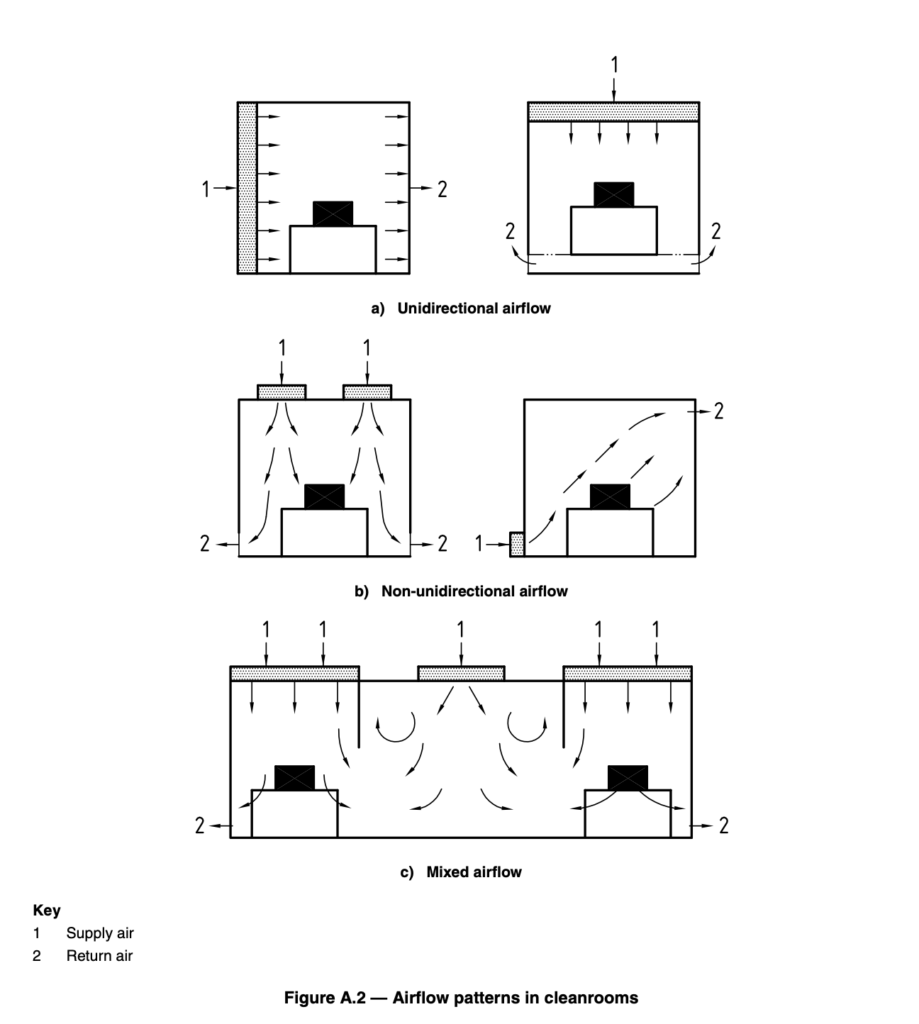
Cleanroom airflow can be unidirectional, non-unidirectional, or mixed — a combination of both. The best cleanroom airflow type will depend on the cleanroom classification. Generally, cleanrooms of an ISO Class 6 or greater can use a mixed or non-unidirectional airflow pattern, while ISO Class 5 (or cleaner) cleanrooms rely on unidirectional airflow.


#1 Unidirectional Cleanroom Airflow


This type of cleanroom air moves in one direction across the room, either horizontally or vertically from fan filter units to the exhaust system that removes “dirty” air. Unidirectional flow requires as little disturbance as possible to maintain a uniform pattern.


#2 Non-Unidirectional Cleanroom Airflow


In a non-unidirectional airflow pattern, air enters the cleanroom from filter units located in multiple locations, either spaced throughout the room or grouped together. There are still planned entrance and exit points for air to flow along more than one path.

Although air quality is less critical compared to unidirectional airflow cleanrooms, special attention should be paid to make sure air is changed thoroughly, minimizing the potential for “dead zones” within the cleanroom. 

Dead zones are areas where air is turbulent or not being changed and may result in deposited particles or a buildup of contaminants.


#3 Mixed Cleanroom Airflow


Mixed airflow combines both unidirectional and non-unidirectional airflow. Unidirectional airflow may be used in specific areas to boost protection around working areas or more sensitive materials, while non-unidirectional airflow still circulates clean, filtered air throughout the rest of the room.

mixed cleanroom airflow


Why Cleanroom Airflow Uniformity Matters


Whether a cleanroom airflow is unidirectional, non-unidirectional, or mixed, having a uniform cleanroom airflow pattern matters. Cleanrooms are meant to be controlled environments where all systems should work to prevent areas where buildup of contaminants can occur — via dead zones or turbulence. 


What is Turbulent Air?


Turbulent air, or chaotic air, in a cleanroom is a serious threat to cleanliness. Turbulent air occurs when the airflow pattern is not uniform.

Think of a current moving through water. If the flow was uniform, all of the water would move steadily at the same speed. Obstructions or varying speeds, like rocks or rapids, impede the uniformity of the flowing water. Similarly, when you sweep your hand through water and see eddies and whirlpools form to the side of the current, that’s turbulence. 

Eddies in water may be harmless, but turbulence in cleanroom airflow can cause the uncontrolled movement of contaminating particles — or dead zones where no air is moving at all, where contaminants can build up and threaten sensitive processes in the cleanroom.


What Causes Turbulent Air in Cleanrooms? 


Turbulence in cleanroom airflow can be caused by non-uniform speeds of air entering the room or obstructions in the path of incoming or outgoing air. Airflow uniformity is about preventing unnecessary turbulent air so the cleanroom can perform at peak efficiency.


Minimizing Turbulence in Cleanrooms


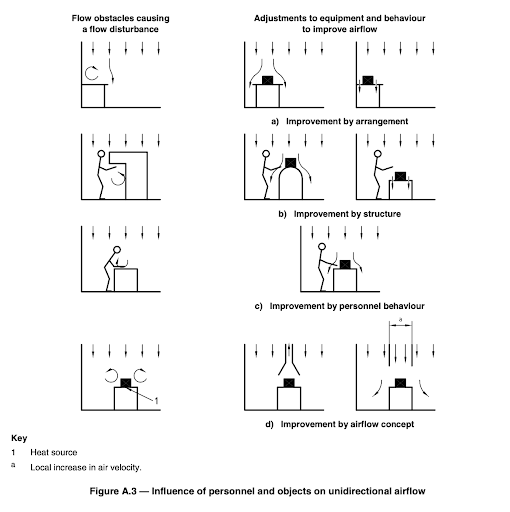
You can minimize turbulence by designing the cleanroom airflow pattern to work with your layout, equipment, furniture, and personnel. The cleanroom should be removing air at the same or similar speed as it enters. This gives air a clear path to flow to prevent turbulence and dead zones.

Obstructions can also cause turbulent air, so make sure that no large furniture or equipment is blocking fan filter units or exhaust. Adjust equipment with aerodynamic attachments or design features to facilitate airflow, use perforated cleanroom tables to allow air to pass through uninhibited, or modify behavior of personnel to not block or impede airflow within critical zones.

Minimizing Turbulence in Cleanrooms


Cleanroom Airflow and Pressurization


Another way to minimize contamination using a uniform airflow pattern to establish positive or negative air pressure. Cleanroom pressurization creates a natural barrier to protect or isolate cleaner or less clean zones, respectively. Using negative and positive pressure can be especially useful for sensitive applications such as the manufacturing of healthcare products, medical research, microelectronics, and more.


Custom Cleanroom Airflow Design


Cleanroom airflow patterns should be designed to work with each unique cleanroom layout and all the furniture, systems, and personnel in the cleanroom for optimal cleanliness during operation. 

A cleanroom engineer uses computational fluid dynamics to map out the cleanroom and place fan filter units and outlets appropriately to meet your classification requirements. This system allows the designer to visualize the pattern of air and make adjustments for cleanroom systems, equipment, and personnel in order to achieve uniformity. It also allows you to anticipate your energy requirements and make your facility as efficient as possible. 

As your ISO cleanroom classification gets lower, having an expertly designed airflow pattern becomes more and more crucial. Work with an expert to make sure your cleanroom airflow is as uniform as possible for your application.


Trust the Angstrom Technology Cleanroom Airflow Design Experts

Designing your cleanroom and need a little help establishing an efficient, uniform airflow pattern? Call the experts at Angstrom Technology. From cleanroom airflow design to HVAC and filtration maintenance, we can help you make the best choices for your budget and your classification. 

Cleanroom Terminology: What Are Air Change Rates?

Cleanroom Terminology: What Are Air Change Rates?

Air Changes per Hour are important factors in determining the design and evaluating the performance of a cleanroom. The air changes per hour, airflow pattern, and exchange efficiency all have significant implications on cleanroom performance and cost, which in turn determines the return on investment for a cleanroom.

What are air changes per hour, and how are they accounted for in cleanroom design? We’ll break down the answers to these questions and more.

What are Air Changes Per Hour?

As defined by ISO 146144-4 standards, air changes per hour refers to the number of times per hour the air in a cleanroom is replaced with clean, filtered, and treated air. It’s calculated by dividing the volume of air sent into the cleanroom as a unit of time by the total volume of the cleanroom. 

Air Changes Per Hour or Air Change Velocity

Cleanrooms, by definition, require air changes in order to meet air quality requirements for particle count and more. As the environment gets more clean with lower ISO classes, more and more air changes are needed to reach stringent classification standards. 

ISO standards express air changes per hour differently for cleanrooms with unidirectional and non-unidirectional airflow. 

Non-Unidirectional Airflow = Air Changes Per Hour

Non-unidirectional, or mixed flow, refers to the airflow pattern in a cleanroom. Typically, cleanrooms that fall within ISO Classes 5 and above use this type of airflow. It is sufficient for removing the designated number and size of particles at a regular rate per their classification standard. 

For cleanrooms that comply with ISO Classes 4-9, hourly air changes per hour are sufficient to express how many times the air in the cleanroom is completely refreshed. Applications like pharmaceutical, packaging and manufacturing, biosciences and health typically fall in this classification range and comply with air changes per hour as described. 

Unidirectional Airflow = Airflow Velocity

As cleanroom classifications become more stringent, the air changes per hour must increase to remove particles and keep the air cleaner. Cleanrooms with unidirectional airflow, typically Class 5 and below, have the strictest cleanroom classifications. To maintain air quality, the air changes per hour is so rapid it is expressed instead as airflow velocity, either in meters per second or feet per minute. 

These cleanroom environments must remain extremely clean, so the constant flow of contaminant-free air, either vertically or horizontally, is vital to keep particles from settling on surfaces and maintain classification standards. 

Cleanroom applications such as microelectronics, sensor manufacturing, and other sensitive processes must be performed in such environments with strict air quality control and consistent removal of contamination.

Air Changes Per Hour and Cleanroom Classifications

air changes per hour are an essential component of cleanroom classification standards. They make it possible to reach the particle count and size restrictions each class sets. Let’s take a look how air changes per hour and classification are related.

ISO 14644-1 Cleanroom Standards

Class

Maximum Allowed Particles (per m3)

Air Changes Per Hour

Airflow Velocity (ft/min)

Ceiling Coverage

≥0.2 µm

≥0.3 µm

≥0.5 µm

≥1 µm

≥5 µm

ISO 1

2.37

1.02

0.35

0.083

0.0029

360-600

60-100

90-100%

ISO 2

23.7

10.2

3.5

0.83

0.029

360-600

60-100

80-100%

ISO 3

237

102

35

8.3

0.29

360-540

60-90

60-100%

ISO 4

2,370

1,020

352

83

2.9

300-540

50-90

50-90%

ISO 5

23,700

10,200

3,520

832

29

240-480

40-80

35-70%

ISO 6

237,000

102,000

35,200

8,320

293

150-240

25-40

25-40%

ISO 7

2.37×10⁶

1,020,000

352,000

83,200

2,930

60-90

10-15

15-20%

ISO 8

2.37×10⁷

1.02×10⁷

3,520,000

832,000

29,300

5-48

1-8

5-15%

ISO 9

2.37×10⁸

1.02×10⁸

35,200,000

8,320,000

293,000

0-25

0-5

5-10%

As you can see from the chart above, classes are organized by three major factors: particle size and count, air changes per hour or airflow velocity, and percentage of ceiling coverage. Once the air changes per hour rises above 200, it is better expressed as airflow velocity in feet per minute. 

Whats My Air Changes Per Hour?

The best air changes per hour for your cleanroom is the one that allows you to reach the required cleanliness required by your cleanroom classification. The level of activity and actions that introduce contaminants in your specific cleanroom may affect the amount of particles generated, and thus the air changes per hour required to remove them.

Your cleanroom’s air changes per hour describes conditions when the room is in operation, but you may lower the air changes per hour when the cleanroom is not in use to save energy and operation costs.  

Designing Cleanrooms to Meet Air Changes Per Hour

Your cleanroom is designed to meet your cleanroom classification. All the systems that support air quality and cleanliness work together to achieve consistency.

To design a cleanroom that meets your classification with adequate air changes per hour, the cleanroom must contain enough fan filter units and a uniform airflow pattern. A greater percentage ceiling coverage of fan filter units is required to reach necessary air changes. 

Although the percentage of ceiling coverage for fan filter units isn’t a metric directly referenced by ISO standards, it helps estimate construction costs. What’s most important is that the cleanroom has the systems it needs to thoroughly and consistently change the air to reach its cleanliness requirements. 

Upgrading Cleanroom Classifications and Air Changes Per Hour

If you need to upgrade your cleanroom to meet stricter classification standards or adapt your facility to handle a more sensitive project, an important step is to increase or adjust the filtration and air changes per hour to remove more particles of a smaller size from the air. 

When moving from ISO Class 7 to ISO Class 6, for example, you’ll need to increase your air changes from 60-90 ACH to 150-240 ACH to filter all but 35,200 particles at 0.5 microns per cubic meter. Consider that, to support this shift, you may need to upgrade your HVAC system. 

What’s My Air Changes Per Hour?

The best air changes per hour for your cleanroom is the one that allows you to reach the required cleanliness required by your cleanroom classification. The level of activity and actions that introduce contaminants in your specific cleanroom may affect the amount of particles generated, and thus the air changes per hour required to remove them.

Your cleanroom’s air changes per hour describes conditions when the room is in operation, but you may lower the air changes per hour when the cleanroom is not in use to save energy and operation costs.  

Designing Cleanrooms to Meet Air Changes Per Hour

Your cleanroom is designed to meet your cleanroom classification. All the systems that support air quality and cleanliness work together to achieve consistency.

To design a cleanroom that meets your classification with adequate air changes per hour, the cleanroom must contain enough fan filter units and a uniform airflow pattern. A greater percentage ceiling coverage of fan filter units is required to reach necessary air changes. 

Although the percentage of ceiling coverage for fan filter units isn’t a metric directly referenced by ISO standards, it helps estimate construction costs. What’s most important is that the cleanroom has the systems it needs to thoroughly and consistently change the air to reach its cleanliness requirements. 

Upgrading Cleanroom Classifications and Air Changes Per Hour

If you need to upgrade your cleanroom to meet stricter classification standards or adapt your facility to handle a more sensitive project, an important step is to increase or adjust the filtration and air changes per hour to remove more particles of a smaller size from the air. 

When moving from ISO Class 7 to ISO Class 6, for example, you’ll need to increase your air changes from 60-90 ACH to 150-240 ACH to filter all but 35,200 particles at 0.5 microns per cubic meter. Consider that, to support this shift, you may need to upgrade your HVAC system.

Meet Your Classification With Cleanroom Professionals

Think you need to update your cleanroom’s air changes per hour? The cleanroom design experts at Angstrom Technology can help! We can evaluate your space and systems to ensure they’re working effectively, and help you upgrade them to change air more efficiently. To learn more, give us a call or reach out online.

medical-packaging-cleanroom-project-7

PHARMACEUTICAL

CLEANROOM

radiopharmaceuticals-cleanroom-1

Advanced

Radiopharmaceuticals 

cleanroom-yellow-rail-dark

Pharmaceutical

Packaging Company

Medical Cleanroom Design Tips: Cleanroom Ceilings and Fan Filter Units

Medical Cleanroom Design Tips: Cleanroom Ceilings and Fan Filter Units

Cleanroom walls, floors, doors, and other components get a lot of attention, but one of the most crucial elements of cleanroom construction is the ceiling. Cleanroom ceilings support many of the essential functions of the space, from housing fan filter units to supporting lighting and other electrical components, fire suppression systems, and more.

This is one area of medical cleanroom design that should not be overlooked. Let’s explore what your cleanroom ceiling can do — particularly when it comes to filtration and fan filter units.

Medical Cleanroom Design: Cleanroom Ceilings

Cleanroom ceilings can take many forms, depending on the requirements of each application, but the most common construction is a grid ceiling.

The grid ceiling of a medical cleanroom must support the frame and ceiling panels, lighting, and heavy fan filter units. The grid frame and all of its contents is supported by sturdy beams attached to your building structure.

With the ceiling panels installed, there should still be enough space between the ceiling and the roof for electrical and control boxes, air inlets, and fan filter unit housings. Walkable cleanroom ceilings must have enough space for a technician to maneuver above the room safely, to perform maintenance without disturbing the controlled environment inside.

Considerations for Cleanroom Ceiling Design

Cleanroom ceilings any any components, such as filters, filter housing, frames, and other penetrations for utilities, sprinklers, or lighting, must be completely sealed to prevent any contaminants from finding their way into the cleanroom. When designing the cleanroom ceiling, no wires, pipes or other obstructions should block or impair the airflow pattern from the fan filter units. 

Medical Cleanroom Ceilings and Fan Filter Units

Fan filter units are the most important part of a cleanroom ceiling. They direct clean, filtered air into your cleanroom and help maintain your classification standard. They also take up the most space, so much of cleanroom design is fitting the rest of the cleanroom — lighting, electrical, and more — around these essential components. 

What Are Fan Filter Units?

Fan filter units protect and facilitate the filtering power of the cleanroom. Combined with proper cleaning, and an expertly designed airflow pattern, fan filter units are responsible for achieving and maintaining your cleanroom classification requirements for allowed particles.

Fan filter units house your hardworking HEPA filters and upstream pre filters in an epoxy, acrylic or polystyrene-coated aluminum frame. They’re attached to the ceiling grid and fixed flush with ceiling panels to direct airflow into the room without creating turbulence.

Types of Fan Filter Units

There are different types of fan filter units, depending on the size, airflow rate, and filter media that works best for your application’s needs. A few of the common options for medical cleanrooms include:

  • Roomside Replaceable fan filter units, which feature housing that is accessible from within the cleanroom. Pharmaceutical cleanrooms require frequent testing and replacement of filters, so room-side-replacement is an advantage. These units have a gel-seal gasket that creates a seamless connection between the filter and the housing.
  • Non-roomside replaceable fan filter units, or NCR fan filter units, which are accessed from overhead the cleanroom. The advantage of NCR units is that they only require filter replacement every 3-5 years, except in certain cases where the cleanroom application generates excessive particulate matter.
  • Reverse airflow fan filter units, which are more common in medical cleanrooms working with hazardous substances, toxic fumes or contagious pathogens. A reverse airflow fan filter can be used to establish negative pressure and isolate contaminants inside the cleanroom.

All cleanrooms require air filtration using HEPA filters. Generally, the more stringent your cleanroom classification, the more fan filter units you’ll need mounted on your cleanroom ceiling. 

As you install more fan filter units, you’ll need to get creative with how other systems are installed on your ceiling. Fortunately, there are creative workarounds, like grid lighting, that leave plenty of room for your cleanroom filtration system.

How Many Fan Filter Units Does My Cleanroom Need?

The number of fan filter units your cleanroom requires depends primarily on your classification, but also your cleanroom layout and the volume of your space.

Your cleanroom classification will dictate the minimum air change rate and particle count requirements for your application. Cleanrooms with less stringent requirements may only require 5-15% ceiling coverage to be dedicated to filtration, while those with fewer particles allowed may require 60-100%.

You can determine the number of fan filters required by comparing the capacity of each filter fan unit with the total volume of your space.

Need some help building the perfect high-performance ceiling to reach your cleanroom classification? Angstrom Technology would love to help your medical cleanroom achieve optimal airflow, filtration, and pressurization for your application. Give us a call to get started!

Conductive vs. Anti-Static Cleanrooms: Which is Better for the Aerospace Industry?

Conductive vs. Anti-Static Cleanrooms: Which is Better for the Aerospace Industry?

Materials, equipment, and processes within aerospace cleanrooms make them more likely to generate static charges, as well as more vulnerable to the effects of static electricity. Metallic materials used to produce aircraft and spacecraft and their components can carry electrostatic charges, but even cleanroom-grade materials that aren’t metallic, such as vinyl or plastic, can generate static electricity.

Managing Static Electricity in Aerospace Cleanrooms

Managing electricity generated by static or other causes is essential for aerospace and defense cleanrooms that work with electronics, sensitive hardware, or unstable compounds. Particularly in aerospace cleanrooms, precautions must be taken to: 

  • Prevent the buildup of charges could attract contaminants to adhere to the surface of hardware, causing them to fail.
  • Limit the chance of sparks which could ignite flammable materials and hazardous substances within the cleanroom.
  • Protect personnel from electrostatic charges which could cause injury or spontaneous muscle movement which could cause damage to themselves, the cleanroom and its products, or others. 

Static control measures can prevent or reduce the severity of hazards that result from static electricity as well as protect sensitive equipment. Using the right materials to manage static charges and allow excess electrons to flow safely to ground can make your aerospace cleanroom safer for your work and your workers.

Dissipative, Insulative, and Conductive vs. Anti-Static Cleanrooms

When it comes to managing static electricity in aerospace cleanrooms, there are a few key terms to know: conductive, anti-static, static dissipative, and insulative. All of these materials interact with static electricity in different ways, which makes them more suitable for some applications over others. Let’s break down each of these static control materials.

Dissipative Cleanroom Materials

Dissipative cleanroom materials are more resistant to the flow of electrons. They allow static charges to travel to ground in a more controlled manner than conductive materials.

Insulative Cleanroom Materials

Insulative cleanroom materials are very resistant to flowing electrons. Not only are these materials difficult to ground, but they can also retain static charges.

Conductive Cleanroom Materials

Conductive cleanroom materials allow electrons to flow easily. They’re used to direct static charges to ground and away from sensitive products, hardware, or substances. The conductive materials themselves must only generate very low charges.

Anti-Static Cleanroom Materials

Anti-static cleanroom materials prevent the buildup of static electricity altogether. Anti-static materials are typically treated with a coating to reduce or remove static charges.

Conductive vs. Antistatic: Which is Better for Aerospace Cleanrooms?

The best materials to use in aerospace cleanrooms for static control are conductive or static dissipative materials like stainless steel, carbon, or hard plastics filled with metal fibers. A grounded copper bar placed around the perimeter of the cleanroom, three feet above the floor, is a common solution.

All materials used to control static in aerospace cleanrooms must be low-outgassing and non-particle shedding. They must not transfer any films or particles that could contaminate sensitive hardware or equipment, which means materials treated with anti-static coatings are also likely unsuitable.

Get Professional Help Managing Static In Your Cleanroom

Not sure if conductive or antistatic is better for your cleanroom? Angstrom Technology’s cleanroom design experts can help you determine the best materials and systems to use for your application. Simply give us a call to get started!